Authoritative technical articles and best practices covering module orientation, mechanical roof mounting, DC string electrical design, chemical grounding boring, and preventive maintenance across Asian climates.
1. Optimal Solar Tilt Angles & Azimuth Orientation Across Asia
The orientation and tilt angle of solar photovoltaic modules directly determine the total kilowatt-hours harvested annually. In the Northern Hemisphere (all target Asian territories), modules must face True South (180° Azimuth). Deviating from South to Southeast or Southwest reduces annual energy yield by 4% to 9%.
| Country & Region |
Latitude Range |
Recommended Fixed Tilt |
Summer Tilt (Optional) |
Winter Tilt (Optional) |
| Pakistan (Lahore, Islamabad, Peshawar) |
31°N – 34°N |
28° to 30° South |
15° South |
42° South |
| Pakistan (Karachi, Sindh Coast) |
24°N – 26°N |
24° to 26° South |
12° South |
38° South |
| India (Delhi NCR, UP, Rajasthan) |
26°N – 29°N |
26° to 28° South |
14° South |
40° South |
| India (Mumbai, Bengaluru, Chennai) |
12°N – 19°N |
15° to 18° South |
10° South |
28° South |
| Philippines (Manila, Luzon) |
14°N – 16°N |
14° to 16° South |
10° South |
22° South |
| Vietnam (Ho Chi Minh City) |
10°N – 11°N |
11° to 13° South |
8° South |
18° South |
| UAE & Saudi Arabia (Dubai, Riyadh) |
24°N – 25°N |
22° to 25° South |
12° South |
36° South |
| Malaysia & Indonesia (KL, Jakarta) |
1°N – 6°S |
8° to 10° Tilt (for rain drainage) |
8° Tilt |
10° Tilt |
2. Chemical Earthing & Grounding Protection Standards (IEC 62305)
Proper electrical grounding is the single most critical safety requirement for rooftop solar systems. Lightning strikes and grid voltage surges can instantly destroy inverter IGBT switches and create severe building fire hazards.
Sub-5 Ohm Earth Resistance Requirement:
Utility regulations (such as NEPRA in Pakistan and Meralco in Philippines) require grounding resistance strictly below 5.0 Ohms (measured using a 3-point digital Earth Tester). Dedicated earth boring (40ft to 60ft deep) with copper bonded rods (16mm diameter) and Bentonite/Marconite conductive chemical compound is mandatory.
Separate AC and DC Earth Pits Protocol:
High-standard engineering requires three separate grounding pits: (1) Frame Grounding (for all solar panel aluminum frames and metallic mounting structures), (2) Inverter AC & DC SPD Grounding, and (3) Lightning Arrester (ESE) Earth Pit placed at least 3 meters away from building structural foundations.
3. Structural Mounting: L2/L3 Galvanized Frames & Wind Uplift
Solar arrays act as large aerodynamic sails during heavy thunderstorms and typhoons. Mounting frames must be engineered to withstand wind gusts up to 130 km/h in inland plains and over 200 km/h in coastal and typhoon-prone zones (Philippines, Vietnam, Chittagong).
- Hot-Dip Galvanized Iron (GI): Ensure steel frames have minimum 80-micron hot-dip zinc coating (ASTM A123 standard) to resist atmospheric corrosion for 25+ years. Cold-spray spray paint degrades within 2 to 3 years.
- Concrete Ballast vs Chemical Epoxy Anchoring: On concrete flat roofs, avoid penetrating the waterproofing layer whenever possible by utilizing precast concrete ballast blocks, or use Hilti chemical epoxy anchors sealed with non-shrink waterproof grout.
- SUS304 Stainless Steel Fasteners: All nuts, bolts, and spring washers connecting aluminum clamps must be SUS304 or SUS316 stainless steel to prevent galvanic bimetallic corrosion between aluminum and steel.
4. DC String Voltage Sizing & Cold Weather Voc Derating
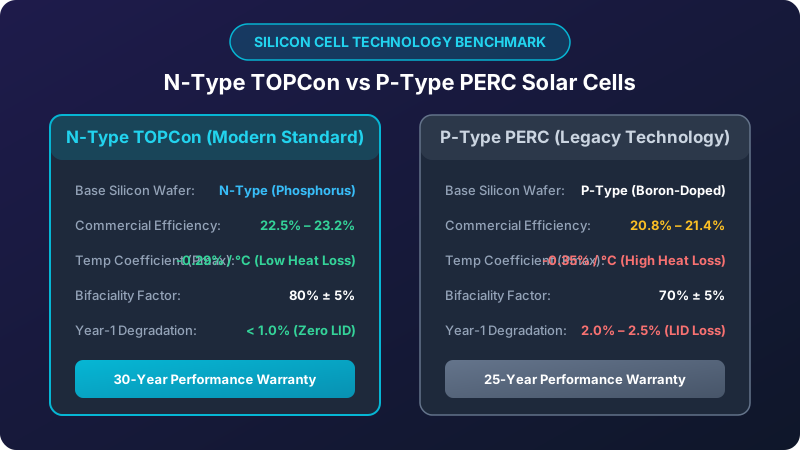
When connecting panels in series into a single inverter MPPT tracker, open-circuit voltage (Voc) increases in cold weather due to the negative temperature coefficient of Voc (-0.26%/°C).
Max String Voc (at -5°C minimum winter temperature) = Panel Voc (STC) × [1 + (-0.0026 × (-5°C - 25°C))] × Number of Panels in Series
For a 585W panel with Voc = 51.5V, a cold winter morning (-5°C) raises string Voc to 55.5V per module. A string of 18 panels will produce 999.0V DC, safely below a 1,000V DC inverter maximum input limit. Exceeding 1,000V DC permanently destroys the inverter's input DC capacitors and voids the manufacturer warranty.
5. Operation, Maintenance & Solar Panel Cleaning Protocols
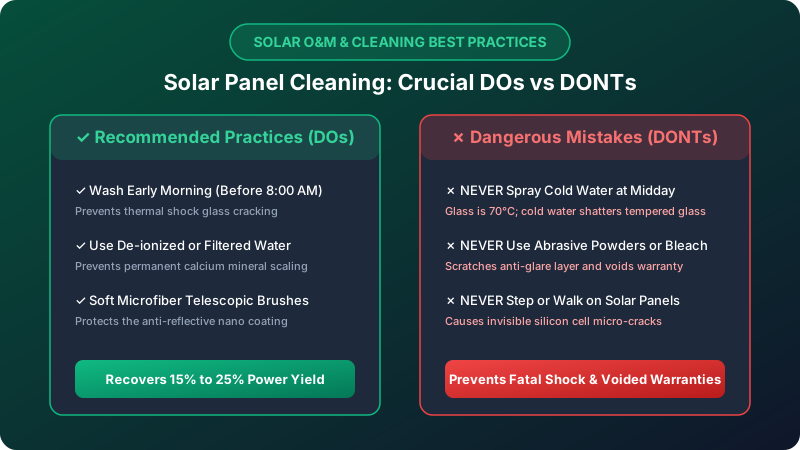
Atmospheric dust, industrial smog, and bird droppings cause significant optical soiling loss across Asian urban centers. Uncleaned solar arrays in cities like Lahore, Delhi, or Karachi can suffer 15% to 25% generation loss within 3 weeks.
Early Morning Cleaning Routine:
Always wash solar modules in early morning (before 8:00 AM) or late evening when the glass is cool. Spraying cold tap water onto scorching midday solar glass (which reaches 70°C) creates extreme thermal shock that can instantly crack tempered front glass and destroy solar cells.
De-ionized Water & Soft Microfiber:
Use low-pressure demineralized water and soft microfiber telescopic brushes. Never use abrasive detergents, wire brushes, or high-pressure power washers above 35 bar, as abrasive cleaning scratches the anti-reflective (ARC) nano-coating and degrades module efficiency permanently.