⚡ System Sizing & Investment Analysis
5kW vs 10kW Solar System: Which Size is Right for Your Home?
When transitioning to solar energy, deciding between a 5 Kilowatt (5 kWp) and a 10 Kilowatt (10 kWp) system is one of the most critical decisions a homeowner will make. The right choice dictates your upfront capital investment, appliance running freedom, grid net metering eligibility, and 25-year financial savings.
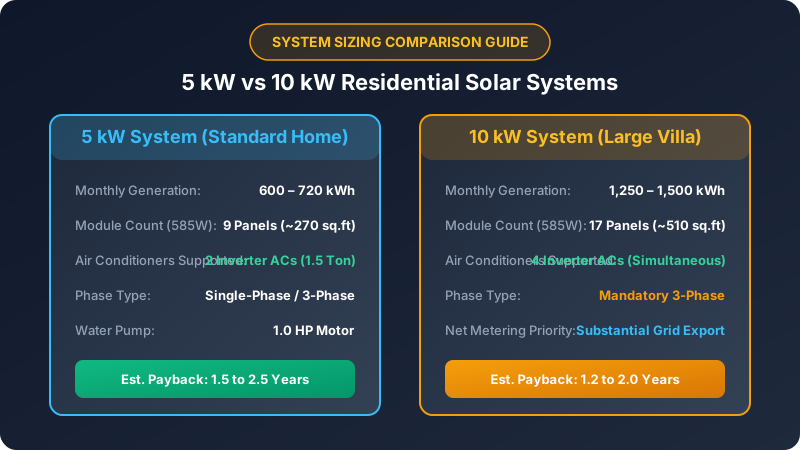
Figure 1: Comprehensive comparison matrix between 5kW residential and 10kW villa solar photovoltaic systems.
1. Executive Summary: 5kW vs 10kW at a Glance
A 5 kW solar system is primarily designed for daytime direct self-consumption in standard 3 to 4-bedroom homes consuming between 500 and 750 electricity units (kWh) per month. In contrast, a 10 kW system is engineered for full energy independence and aggressive grid net metering export in large residences, duplexes, and villas consuming 1,000 to 1,600 units monthly.
| System Metric |
5 kW System Setup |
10 kW System Setup |
Key Difference |
| Daily Generation (Summer) |
22 to 26 kWh / day |
45 to 54 kWh / day |
10kW generates 2x more daily energy |
| Monthly Generation |
600 to 750 units/month |
1,250 to 1,550 units/month |
10kW wipes out high-slab luxury bills |
| Number of 585W Panels |
8 to 9 Panels |
17 to 18 Panels |
5kW requires half the roof footprint |
| Required Shade-Free Roof |
~270 sq.ft (25 m²) |
~510 sq.ft (48 m²) |
Essential for roof space planning |
| Air Conditioners (Inverter) |
2x 1.5-Ton Inverter ACs |
4x 1.5-Ton Inverter ACs |
10kW runs entire household cooling |
| Grid Connection Type |
Single-Phase or 3-Phase |
Mandatory 3-Phase |
10kW requires 3-phase utility meter |
| Net Metering Performance |
Covers daytime; modest export |
Heavy surplus exported to grid |
10kW generates winter credit rollover |
| Estimated Payback Horizon |
1.5 to 2.5 Years |
1.2 to 2.0 Years |
10kW pays back faster per installed Watt |
2. Appliance Load Capacity: What Can Each System Realistically Run?
Understanding simultaneous electrical load capacity is essential to avoid overloading your solar inverter during scorching afternoon hours.
What a 5 kW System Can Run Concurrently:
- 2x 1.5-Ton Inverter ACs (Running steadily at ~600W each = 1,200W).
- 1x Refrigerator & 1x Deep Freezer (~350W running).
- 1x 1.0 HP Water Pump (Daytime operation, ~750W).
- 6x BLDC Ceiling Fans (~210W total).
- 15x LED Lights, Wi-Fi Routers, LED TV (~200W).
- Peak Afternoon Combined Running Load: ~3,200W to 3,800W (Safely within 5kW inverter capacity).
What a 10 kW System Can Run Concurrently:
- 4x 1.5-Ton Inverter ACs (Running concurrently = 2,400W).
- 1x 2.0 HP Submersible Water Pump (~1,500W).
- 1x Electric Instant Geyser / Dishwasher (~2,000W).
- 2x Inverter Refrigerators & Deep Freezers (~500W).
- Automatic Washing Machine & Iron (~1,200W).
- Whole-House LED Lighting, Fans, Computers, Security CCTV (~600W).
- Peak Afternoon Combined Running Load: ~7,500W to 8,500W + 1.5kW to 2.5kW continuous export to the grid.
3. Turnkey Installation Costs: 5kW vs 10kW Across Asia (2026)
A complete turnkey installation includes Tier-1 N-Type TOPCon panels, on-grid/hybrid string inverter, hot-dip galvanized mounting structures, pure DC copper cabling, AC/DC distribution boxes with Level-2 SPDs, sub-5 Ohm earthing, and utility net metering approvals.
| Country & Currency |
5 kW Turnkey Package |
10 kW 3-Phase Package |
Scale Advantage (Economy of Scale) |
| 🇵🇰 Pakistan (PKR) |
Rs. 520,000 – 580,000 |
Rs. 920,000 – 1,050,000 |
10kW costs ~10% less per Watt than 5kW |
| 🇮🇳 India (INR - Net after PM Surya Ghar) |
₹ 202,000 (Gross ₹280k) |
₹ 412,000 (Gross ₹490k) |
Includes ₹78,000 Central CFA Subsidy |
| 🇵🇭 Philippines (PHP) |
₱ 235,000 – 265,000 |
₱ 440,000 – 495,000 |
Includes Meralco ERC filing fees |
| 🇧🇩 Bangladesh (BDT) |
৳ 340,000 – 385,000 |
৳ 640,000 – 720,000 |
Includes SREDA net metering inspection |
| 🇦🇪 UAE / 🇸🇦 Saudi (AED / SAR) |
19,000 – 22,000 AED |
36,000 – 42,000 AED |
Includes DEWA Shams Dubai / SEC engineering NOC |
4. Grid Phase Infrastructure: Single-Phase vs 3-Phase Limitations
A crucial technical factor often overlooked by homeowners is their building's grid connection phase:
- Single-Phase Grid Limit (Up to 4kW - 5kW Max): Electric distribution utilities across South Asia (e.g. LESCO, K-Electric, BSES, Meralco) generally do not permit grid solar export above 4.0 kW to 5.0 kW on a single-phase connection to prevent phase voltage unbalance on neighborhood distribution transformers.
- 3-Phase Requirement for 10kW: A 10 kW system strictly requires a 3-Phase 400V electrical connection. If your property currently has a single-phase meter, you must submit a phase-conversion request to your utility company before commissioning a 10 kW on-grid inverter.
5. The Definitive Buyer's Decision Flowchart
Choose a 5 kW Solar System If:
- Your monthly electric bill is between Rs. 30,000 and Rs. 50,000 (400 to 750 units/month).
- You only operate 1 to 2 air conditioners during daylight hours.
- Your available unshaded rooftop area is limited to under 300 sq.ft.
- Your property is connected to a single-phase electricity line.
- Your upfront investment budget is under Rs. 600,000 (or $2,000 USD).
Choose a 10 kW Solar System If:
- Your monthly electric bill exceeds Rs. 70,000 to Rs. 150,000+ (1,000+ units/month).
- You run 3 to 4 air conditioners, heavy water pumps, or plan to charge an Electric Vehicle (EV).
- You have over 500 sq.ft of unshaded rooftop area.
- You already have (or can upgrade to) a 3-Phase electrical connection.
- You want complete zero-bill status and massive summer credit rollover via Net Metering.
SP
System Sizing Analysis by SolarPrice.Asia Engineering Team
Certified Solar PV Systems Designers & Power Economists
Our comparative evaluations are calculated using verified Asian utility tariff slabs, actual appliance energy profiles, and distributor hardware spot prices.