Live Market Rates
Loading current market rates...
Home Load Sizer Calculator ROI & Payback Calculator Equipment Price Matrix Net Metering & Subsidies Tier-1 Brands Engineering Guides ๐Ÿ‡ต๐Ÿ‡ฐ Pakistan Portal ๐Ÿ‡ฎ๐Ÿ‡ณ India Portal ๐Ÿ‡ง๐Ÿ‡ฉ Bangladesh Portal ๐Ÿ‡ต๐Ÿ‡ญ Philippines Portal ๐Ÿ‡ป๐Ÿ‡ณ Vietnam Portal ๐Ÿ‡ฎ๐Ÿ‡ฉ Indonesia Portal ๐Ÿ‡ฆ๐Ÿ‡ช ๐Ÿ‡ธ๐Ÿ‡ฆ UAE & Saudi Portal ๐Ÿ‡ฒ๐Ÿ‡พ ๐Ÿ‡น๐Ÿ‡ญ Malaysia & Thailand
๐Ÿ”Œ Electrical Engineering Guide

Hybrid Inverter vs On-Grid Inverter: Technical Differences & Wiring Explained

The solar inverter is the computational brain and power conversion core of any photovoltaic system. Selecting between a pure On-Grid (Grid-Tied) String Inverter and a multi-source Hybrid Storage Inverter dictates whether your home can survive power outages, store solar energy for the night, and export surplus power to the utility grid.

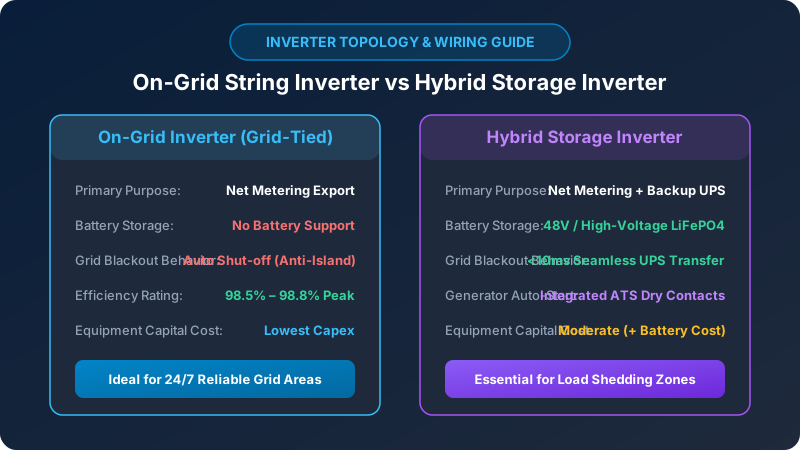
Hybrid Inverter vs On-Grid String Inverter Architecture
Figure 1: Architectural comparison between On-Grid String and Hybrid Storage inverters.

1. Executive Summary: Core Architectural Differences

An On-Grid Inverter (such as Huawei SUN2000 or Sungrow SG) is designed solely to convert Direct Current (DC) electricity from solar panels into Alternating Current (AC) synchronized with the utility grid frequency (50 Hz). It has no battery connections and shuts down immediately when the grid fails.

A Hybrid Storage Inverter (such as Deye SUN-SG04 or Growatt SPH) combines three devices in a single chassis: a grid-tied net metering inverter, a high-speed bi-directional battery charger, and an uninterruptible power supply (UPS) transfer switch capable of switching from grid to battery in under 10 milliseconds.

Feature & Parameter On-Grid String Inverter Hybrid Storage Inverter Engineering Significance
Battery Storage Support None (No DC Battery Ports) Integrated 48V / HV LiFePO4 Hybrid allows nighttime energy storage
Behavior During Power Blackout Auto Shut-off (Anti-Island) < 10ms UPS Transfer On-grid provides zero backup during outages
Net Metering Export Full Bi-directional Export Full Bi-directional Export Both support green meter credits
Conversion Efficiency 98.5% โ€“ 98.8% Peak 97.5% โ€“ 98.0% Peak On-grid is slightly more efficient
Generator Integration (ATS) Requires external manual changeover Integrated Dry Contact Auto-Start Hybrid can auto-start diesel generators
Capital Equipment Cost Lower Initial Cost Higher Initial Cost (+ Battery) Hybrid provides energy security

2. The Anti-Islanding Conundrum: Why On-Grid Solar Shuts Down in Outages

A common frustration among new solar buyers in developing Asian markets is discovering that their on-grid solar system stops producing power the moment a neighborhood blackout or load shedding occursโ€”even on a cloudless, bright afternoon.

This shutdown is not a hardware defect; it is a mandatory global safety regulation known as Anti-Islanding Protection (IEC 62116 / IEEE 1547). When public grid power drops, utility linemen must climb electrical poles to repair fallen lines and blown transformers. If on-grid solar inverters continued feeding power into the dead transmission wires, linesmen would face lethal electrical shocks.

How Hybrid Inverters Solve This Problem: Hybrid inverters feature a dedicated internal physical isolation switch (Automatic Transfer Switch / ATS). When a grid outage occurs, the hybrid inverter physically disconnects the main grid input terminal in under 10 milliseconds, creating a safe, localized micro-grid on its dedicated UPS / Essential Load Port without energizing external street power lines.
3. DC-Coupled vs AC-Coupled Storage Architecture

When incorporating battery storage into a residential solar array, two main electrical coupling methods exist:

DC-Coupled Architecture (Standard Hybrid)

Solar panels and the 48V/51.2V LiFePO4 battery share the same DC bus inside the hybrid inverter. High-voltage DC from panels is stepped down directly to charge the battery with minimal conversion loss (95%+ round-trip efficiency). Best for new solar installations.

AC-Coupled Retrofit Architecture

If you already have an existing On-Grid string inverter installed, you can add a dedicated AC-coupled battery storage inverter without replacing the existing string inverter. Power flows DC -> AC -> DC (into battery), resulting in slightly lower efficiency (88%โ€“91%) but preserving your existing net metering investment.

4. Top Inverter Brands & Models in Asian Markets (2026)

Deye SUN-SG04LP3

3-Phase Hybrid

Available in 8kW, 10kW, 12kW, and 15kW ratings. Operates with safe 48V/51.2V low-voltage LiFePO4 batteries, supports generator auto-start, smart load shedding control, and parallel multi-inverter stacking up to 16 units.

Huawei SUN2000-M1

On-Grid String

Benchmark on-grid string inverter. Natural convection cooling (zero fan noise), AI-powered Arc-Fault Circuit Interruption (AFCI), and seamless cloud monitoring via the FusionSolar app.

Growatt SPH / MOD Series

Residential Favorite

Extremely popular across Pakistan, India, and Southeast Asia. Features dual MPPT trackers with 98.4% efficiency, compact wall-mount footprint, and high DC oversizing capacity.

5. Which Inverter Type Should You Buy?

Buy an On-Grid Inverter If:

  • You live in an area with 24/7 reliable grid electricity and zero load shedding (e.g. Dubai, Singapore, upscale metro districts).
  • Your primary goal is maximum financial ROI and lowest upfront capital cost.
  • You have no desire or budget to purchase expensive battery banks.

Buy a Hybrid Inverter If:

  • You experience frequent electrical load shedding, blackouts, or voltage instability (common across Pakistan, Bangladesh, regional India, and rural Philippines).
  • You want continuous 24/7 power for medical equipment, work computers, and nighttime bedroom air conditioning.
  • You want the flexibility to add lithium battery storage now or in the future without replacing the inverter.
Size Your Inverter Capacity โ†’ Compare Inverter Spot Prices โ†’
SP

Inverter Engineering Guide by SolarPrice.Asia Technical Team

Certified Power Electronics & Solar PV Systems Engineers

Our inverter evaluations are verified against manufacturer factory datasheets, IEC 62109 safety standards, and real-world grid performance telemetry across Asian electrical networks.