Live Market Rates
Loading current market rates...
Home Load Sizer Calculator ROI & Payback Calculator Equipment Price Matrix Net Metering & Subsidies Tier-1 Brands Engineering Guides 🇵🇰 Pakistan Portal 🇮🇳 India Portal 🇧🇩 Bangladesh Portal 🇵🇭 Philippines Portal 🇻🇳 Vietnam Portal 🇮🇩 Indonesia Portal 🇦🇪 🇸🇦 UAE & Saudi Portal 🇲🇾 🇹🇭 Malaysia & Thailand
🧼 Operations & Maintenance Handbook

How to Clean Solar Panels Safely: DOs, DONTs & Maintenance Schedules

Atmospheric dust, vehicular pollution, urban smog, and bird droppings form an opaque barrier over photovoltaic glass. In Asian cities, uncleaned solar panels lose 15% to 25% of their daily energy generation within three weeks. Below is the definitive, field-tested guide on how to wash panels safely without cracking tempered glass or voiding manufacturer warranties.

Solar Panel Cleaning DOs and DONTs
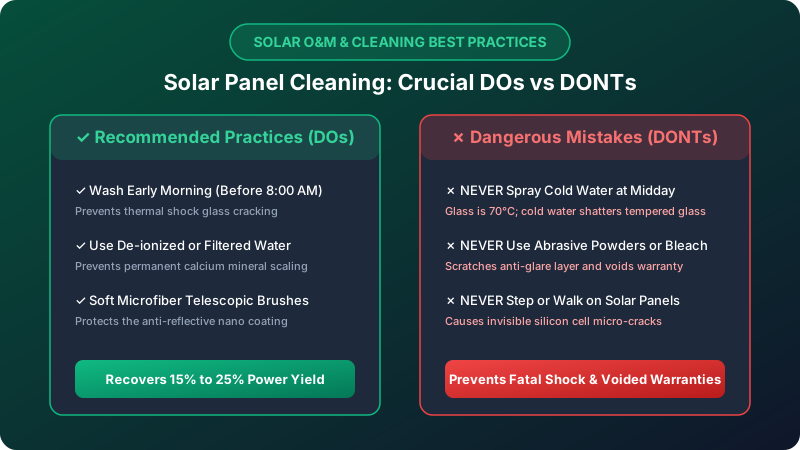
Figure 1: Essential DOs and DONTs for residential and commercial solar panel maintenance.

1. The Physics of Soiling: Why Dust Drastically Reduces Kilowatt-Hours

Photovoltaic modules generate electricity when sunlight photons strike silicon electrons. When microscopic dust particles (silica, carbon soot, fine clay) accumulate on the front tempered glass, they physically block and scatter incident photons (optical extinction).

In cities like Lahore, New Delhi, Karachi, Cairo, and Riyadh, particulate matter (PM2.5 and PM10) settles rapidly onto low-tilt arrays. In a 10 kW system producing 50 kWh daily, a 20% soiling loss means losing 10 units per day (300 units per month)—wasting thousands in utility savings.

2. Critical Timing: Why Midday Cleaning Shatters Solar Glass

The single most destructive mistake homeowners and untrained maintenance staff make is washing solar panels during the middle of a sunny day (between 11:00 AM and 3:30 PM).

The Physics of Thermal Shock:

On a 40°C summer day, dark photovoltaic cells absorb infrared radiation and reach surface temperatures of 65°C to 75°C. When tap water at 22°C is sprayed onto this scorching glass, the rapid localized contraction creates massive internal mechanical tension (thermal shock), causing the 3.2mm tempered glass to instantly spiderweb and crack. Manufacturer warranties do NOT cover thermal shock damage.

The Golden Rule: Always clean panels in the early morning before 8:00 AM (when the glass is cool from the night) or in the late evening after 6:30 PM once the sun has completely set.
3. Water Chemistry: Tap Water vs De-ionized Water

The chemical composition of cleaning water directly impacts the long-term optical transparency of your solar panels:

4. Recommended Cleaning Frequency by Asian Region

Region & Climate Recommended Cleaning Frequency Key Environmental Factors
North India & Pakistan Plains (Lahore, Delhi, Faisalabad) Every 7 to 10 Days Heavy urban dust, construction particulate, agricultural burning, and winter smog.
Middle East Desert (Dubai, Riyadh, Abu Dhabi) Every 5 to 7 Days Fine silica desert sand and dust storms; robotic waterless brushes recommended.
Tropical Southeast Asia (Manila, Bangkok, Jakarta) Every 15 to 20 Days Frequent monsoon rains provide natural washing, but humidity causes algae and bird dropping adhesion.
Coastal Regions (Karachi, Chittagong, Cebu) Every 10 to 14 Days Airborne sea salt deposits require regular freshwater rinsing to prevent frame corrosion.

5. Crucial Safety Precautions for Rooftop Workers

6. Automated Robotic & Waterless Cleaning for Commercial Roofs

For commercial textile mills, factories, and desert solar farms exceeding 100 kWp, manual washing with water hoses becomes economically unfeasible and squanders precious municipal water supplies.

Track-Mounted Waterless Robots:

Autonomous cleaning robots (e.g. Ecoppia, Sol-Bright) traverse entire panel rows at night using soft silicone wipers and controlled airflow, sweeping away 99.5% of airborne particulate without consuming a single drop of water.

Hydrophobic Nanocoatings:

Applying certified anti-static hydrophobic glass sealants creates a lotus-leaf effect where morning condensation and light rain showers bead up and naturally roll down the panel surface, washing away loose dust particles automatically.

View Full Engineering Guides → Calculate System Generation →
SP

O&M Engineering Guide by SolarPrice.Asia

Solar PV Operations & Maintenance Specialists

Guidelines are structured in accordance with IEC 62446 photovoltaic maintenance standards, manufacturer warranty terms, and field engineering data across Asian climate zones.