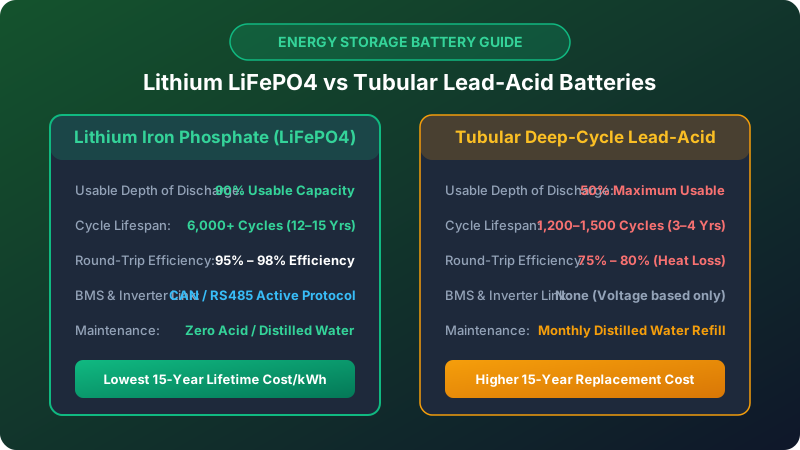
1. Electrochemical Comparison: LiFePO4 vs Lead-Acid
While lead-acid batteries have dominated backup power for over a century, Lithium Iron Phosphate (LiFePO4) has emerged as the global gold standard for residential and commercial stationary solar storage:
| Performance Metric | Lithium LiFePO4 (48V / 51.2V) | Tubular Deep-Cycle Lead-Acid | Practical Impact |
|---|---|---|---|
| Usable Depth of Discharge (DoD) | 90% Usable | 50% Max Usable | A 5.12kWh LiFePO4 delivers 4.6kWh; Lead-Acid delivers only 2.5kWh. |
| Cycle Life (to 80% Retention) | 6,000+ Cycles (12–15 Years) | 1,200–1,500 Cycles (3–4 Years) | Lithium outlasts 4 lead-acid battery banks. |
| Round-Trip Efficiency | 95% to 98% Efficiency | 75% to 80% Efficiency | Lead-acid wastes 20% of stored energy as heat. |
| Charge Rate (C-Rating) | 0.5C to 1.0C (Full charge in 1–2 hrs) | 0.1C to 0.2C (Requires 8–10 hrs) | Lithium recharges rapidly during brief solar/grid windows. |
| Maintenance & Gas Emission | Sealed & Zero Gas (Indoor safe) | Emits explosive hydrogen gas; requires monthly distilled water refill | Lithium requires zero maintenance. |
| Inverter Communication | Active CAN / RS485 digital link | None (Inverter estimates state of charge via voltage) | Lithium BMS prevents cell overcharge and thermal runaway. |